
Align Performance Management With Skills Development And Unleash Your Organization's Potential
Bridging the Gap Between What You Measure and What You Need to Grow

In today's rapidly evolving business landscape, the traditional approach to performance management is fundamentally misaligned with organizational success. While 83% of employees would stay longer at companies with a skills-first approach, and the World Economic Forum projects disruption in nearly half of the global workforce's core skills by 2027, many organizations continue to rely on outdated performance systems that fail to develop the capabilities they need to thrive.
The solution lies in aligning performance management with skills development—a strategic integration that transforms how organizations measure, develop, and retain talent. This alignment doesn't just improve individual performance; it creates a competitive advantage that drives measurable business results. Companies embracing skills-first performance management report twice the revenue growth rates and experience up to 5 times higher transformation efficiency compared to traditional approaches.
Rationale for Integration
The Changing Landscape of Employee Performance Management
The traditional performance management model—built around annual reviews, static job descriptions, and backward-looking assessments—is crumbling under the weight of modern workplace demands. Today's organizations face unprecedented challenges that require a fundamentally different approach to managing and developing talent.
The skills shortage crisis has reached critical proportions. Not only, as mentioned earlier, will nearly half of the global workforce's core skills be disrupted by 2027, green skills vacancies are projected to grow from 67 million in 2025 to 241 million by 2030. This massive skills gap creates both urgent challenges and significant opportunities for organizations willing to reimagine their approach to performance management.
The shift is already underway. Forward-thinking organizations are moving from compliance-based annual reviews to continuous, development-oriented systems. MIT Sloan research finds that the future of performance management is more data-driven, more flexible, more continuous, and more development-oriented. These organizations recognize that performance management must evolve from a backward-looking evaluation tool to a forward-focused development accelerator that attracts and trains talent..
Employee expectations have fundamentally changed. Modern workers—particularly younger generations—demand weekly development feedback and continuous learning opportunities. They expect their career development to be collaborative, with those having career-supportive managers being twice as likely to remain at their organization. The traditional model of waiting for annual reviews to understand performance and growth opportunities no longer meets these expectations.
The Strategic Value of Aligning Performance with Skill Building
The integration of performance management with skills development creates exponential value that extends far beyond traditional HR metrics. Across the organizations implementing this alignment, 58% report improvements in employee performance and 63% experience a positive impact on talent retention.
Business agility becomes a competitive advantage. When performance systems focus on skill development, organizations can rapidly adapt to market changes, technological disruptions, and evolving customer needs. Skills-first companies demonstrate 5x higher transformation efficiency compared to traditional role-based methods, enabling them to pivot quickly and capitalize on emerging opportunities.
Talent optimization reaches new levels. By aligning performance measurement with skill development, organizations unlock the full potential of their workforce. Research shows that 87% of employees believe their organizations do not fully utilize their skills. Proper alignment ensures that talent is not just evaluated but actively developed and deployed where it can create maximum value.
Companies with strong performance management practices improve employee engagement and motivation, with research showing a 17% increase in productivity. Those focused on "performance through people" strategies provide an average of 74 hours of training per employee, resulting in 2x faster revenue growth and 4.3x more likelihood of maintaining strong financial performance.
Culture of Continuous Learning and Adaptability
The alignment of performance management with skills development creates a culture of continuous learning that becomes self-reinforcing and increasingly valuable over time. This cultural transformation is essential for organizational sustainability in an era of constant change.
Learning becomes part of daily work, not an additional burden. As one expert notes, "Development is no longer that extra thing we do. It is part of work now for everyone". When performance systems are aligned with skill development, learning opportunities naturally emerge from performance conversations, making growth a seamless part of the employee experience.
Adaptability becomes organizational DNA. Organizations with aligned systems develop what researchers call "learning agility"—the ability to quickly acquire new skills and apply them in novel situations. This capability becomes crucial as technological innovation continues at an exponential rate, requiring constant upskilling and reskilling of the workforce.
Employee engagement reaches new heights. When performance discussions are frequent and focus on growth and development rather than just evaluation, employees become 3.6 times more likely to feel motivated to do outstanding work. This engagement translated directly into improved performance, innovation, and retention.
Assessing Skills and Performance Together
Skills Assessments as the Foundation for Objective Reviews
The integration of skills assessments into performance management creates an objective, data-driven foundation that eliminates much of the subjectivity and bias inherent in traditional review processes. This approach transforms performance conversations from potentially contentious evaluations into collaborative development discussions.
Competency-based evaluation frameworks provide clear, measurable criteria for assessing performance. Rather than relying on vague descriptors or subjective impressions, skills-based assessments focus on demonstrable capabilities and their application in real work situations. Research shows that organizations using skills-based performance management are 12% more likely to make quality hires and see significant improvements in employee development outcomes.
360-degree skills feedback creates a comprehensive view of employee capabilities. Modern skills assessment incorporates input from multiple stakeholders—peers, subordinates, customers, and supervisors—to create a holistic understanding of an individual's skills profile. This approach reduces bias and provides more accurate insights into both current capabilities and development needs.
Real-time skills tracking enables continuous performance monitoring. Advanced organizations use technology platforms to track skill development and application in real-time, moving beyond the limitations of periodic reviews. This continuous assessment model provides immediate feedback and enables rapid course corrections, leading to faster skill development and improved performance outcomes.
Behavioral and technical competency integration ensures comprehensive evaluation. Effective skills assessments evaluate both hard skills (technical competencies) and power or soft skills (leadership, communication, collaboration), providing a complete picture of employee capabilities. This comprehensive approach enables more targeted development planning and better alignment between individual strengths and organizational needs.
Identifying and Closing Organizational Skills Gaps
The systematic identification and closure of skills gaps becomes a strategic capability when performance management is aligned with skills development. This process transforms reactive problem-solving into proactive capability building.
Skills inventory and mapping create organizational visibility into current capabilities. By conducting comprehensive skills audits across the organization, leaders gain clear insights into existing strengths, emerging gaps, and future needs. This inventory serves as the foundation for strategic workforce planning and development initiatives.
Gap analysis drives targeted interventions. Once current skills are mapped against future needs, organizations can identify specific gaps and develop targeted strategies to address them. This might include upskilling current employees, strategic hiring, or reorganizing teams to leverage existing capabilities better.
Predictive skills planning anticipates future needs before gaps become critical. Advanced organizations use data analytics and market intelligence to predict which skills will become essential and begin developing them proactively. This forward-looking approach prevents skills shortages from becoming performance bottlenecks.
Cross-functional skills development breaks down silos and increases organizational agility. When skills assessments reveal capabilities that can be leveraged across departments, organizations can create more flexible teams and reduce dependencies on specialized roles.
Case Study: Using Skills Audits for Executive Decision-Making
A compelling example of skills-performance alignment in action comes from the executive assessment and development space, where organizations are using comprehensive skills audits to make critical leadership decisions and drive performance improvements.
The Challenge: A major technology firm was experiencing inconsistent leadership performance across divisions, with some teams significantly outperforming others despite similar market conditions and resources. Traditional executive evaluations provided limited insights into the root causes of these performance disparities.
The Skills-First Solution: The organization implemented a comprehensive executive skills audit that evaluated leadership capabilities across five key dimensions: strategic thinking, operational excellence, people leadership, innovation management, and cultural alignment. This assessment combined behavioral simulations, 360-degree feedback, psychometric evaluations, and real-world case studies.
Assessment Methodology: The skills audit used multiple evaluation methods:
Simulation exercises that mimic real-world decision-making challenges, shown to increase leadership effectiveness by 30% compared to traditional assessment methods
Behavioral interviews focused on specific competency demonstration
Data-driven performance analysis linking individual skills to business outcomes
Peer and subordinate feedback on leadership effectiveness in practice
Business Impact: The skills audit revealed that high-performing executives shared specific competency patterns that were lacking in underperforming leaders. Based on these insights, the organization:
Developed targeted leadership development programs addressing identified skill gaps
Restructured teams to leverage individual leadership strengths better
Created succession planning strategies based on demonstrated competencies rather than tenure or titles
Implemented continuous skills monitoring to track leadership development progress
Results: Within 18 months, the organization saw:
25% improvement in leadership decision-making effectiveness
20% increase in team performance across previously underperforming divisions
15% reduction in leadership turnover
12% increase in employee engagement scores
Key Learning: The case demonstrates that when skills assessments are integrated into executive performance management, they provide actionable insights that drive measurable business improvements. The objective nature of skills-based evaluation eliminates much of the subjectivity in leadership assessment and creates clear pathways for development.
Designing Integrated Performance and Learning Systems
Linking Individual Development Plans (IDPs) to Organizational Objectives
Changing from job-based performance measurements to individual development plans turns a top-down bureaucratic exercise into a strategic business tool for acquiring skills that align with expected skills needs. This represents one of the most significant opportunities in modern performance management. When properly designed and implemented, Individual Development Plans become the connective tissue between personal growth and organizational success.
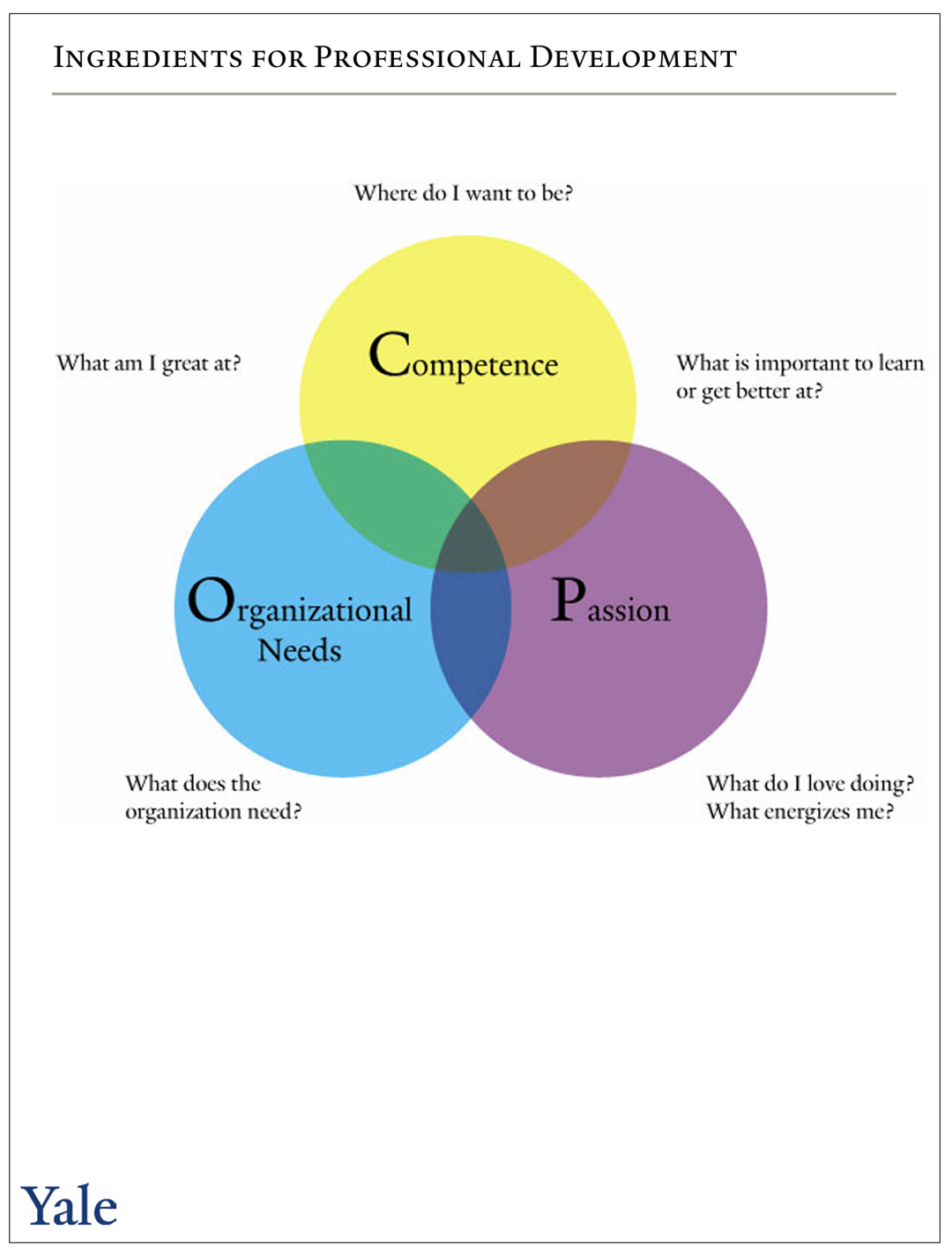
The strategic alignment framework ensures that individual development directly supports business objectives. Effective IDPs begin with a clear understanding of organizational goals and the skills required to achieve them. The Ingredients for Professional Development approach developed by Yale University is illustrated in the Venn diagram below—effective development goals exist at the intersection of individual competence, organizational need, and personal passion. This three-way alignment ensures that development efforts create value for both the employee and the organization.
Competency-based goal setting creates measurable development objectives. Rather than vague aspirations like "improve leadership skills," aligned IDPs establish specific, measurable competency targets. For example, a development goal might be "demonstrate strategic thinking competency by successfully leading cross-functional project planning for a Q3 initiative, as measured by stakeholder feedback and project outcome metrics." This specificity enables both tracking progress and measuring business impact.
Skills pathway mapping creates precise development trajectories. Advanced IDPs map out the specific skills journey required to move from current capabilities to target competencies. This might include formal training, experiential learning opportunities, mentoring relationships, and stretch assignments—all designed to build specific capabilities that align with both individual career aspirations and organizational needs.
Regular alignment reviews ensure continued relevance. As business priorities shift and individual interests evolve, IDPs must be regularly updated to maintain alignment. Leading organizations conduct quarterly IDP reviews that assess progress, adjust goals, and ensure continued alignment with changing business needs.
Using Quarterly/Annual Reviews to Update Learning Trajectories
The integration of learning trajectory updates into regular performance cycles transforms static development plans into dynamic, responsive growth strategies that evolve with both individual progress and organizational needs.
Quarterly skills assessment cycles provide frequent recalibration opportunities. Rather than waiting for annual reviews to adjust development plans, leading organizations conduct quarterly skills assessments that evaluate progress, identify new development needs, and adjust learning trajectories accordingly. This frequency enables rapid response to changing business requirements and accelerated individual development.
Performance data integration informs learning trajectory adjustments. When performance management systems capture both skills development and business outcome data, quarterly reviews can identify which learning activities are most effective at driving performance improvements. This data-driven approach enables continuous optimization of development strategies.
Future-focused planning uses performance cycles to anticipate development needs. Modern performance reviews are shifting from backward-looking evaluation to forward-focused development planning. Quarterly reviews examine not just current performance but anticipated future challenges and the skills required to address them. This proactive approach ensures that learning trajectories stay ahead of business needs.
Cross-functional exposure planning leverages performance cycles to broaden development opportunities. Regular reviews can identify opportunities for employees to develop skills through exposure to different functions, departments, or projects. This approach accelerates learning while building organizational capability and flexibility.
Key Metrics: Competency Progression and Business Outcomes
The measurement of integrated performance and learning systems requires metrics that capture both skill development and business impact. These metrics must demonstrate clear connections between individual growth and organizational success.
Competency progression indicators track skill development velocity and depth:
Skills acquisition rate: Speed at which individuals develop new competencies
Proficiency advancement: Movement from novice to expert levels in key skills
Skills application effectiveness: Quality of skill demonstration in real work situations
Cross-functional capability growth: Expansion of skills beyond core role requirements
Business outcome correlations connect skill development to organizational results:
Performance improvement metrics: Direct correlation between skills development and individual performance scores
Project success rates: Connection between team skills profiles and project outcomes
Innovation indicators: Relationship between learning activities and innovative contributions
Customer satisfaction scores: Impact of skills development on external stakeholder experiences
Return on development investment measures the financial impact of integrated systems:
Productivity improvements: Quantifiable increases in output or efficiency following skills development
Revenue generation: Direct attribution of sales or business development to specific competencies
Cost reduction: Savings achieved through improved skills and capabilities
Retention value: Financial impact of reduced turnover due to effective development programs
Leading indicators predict future performance based on current development activities:
Learning engagement scores: Participation and completion rates in development activities
Skills gap reduction rates: Speed at which identified gaps are being closed
Development goal achievement: Success rates in meeting IDP objectives
Manager coaching effectiveness: Quality and frequency of development-focused conversations
Organizational capability metrics measure system-wide impact:
Skills coverage ratios: Percentage of critical competencies adequately represented in the workforce
Succession readiness: Availability of qualified internal candidates for key roles
Agility indicators: Speed of adaptation to new challenges or opportunities
Learning culture strength: Employee perception of development opportunities and support
These metrics create a comprehensive view of how integrated performance and learning systems drive both individual growth and organizational success, enabling continuous optimization and demonstrable ROI from development investments.
Building Customized Growth Pathways
Structuring Personalized Career Paths and Promotions Around Skills
The evolution from traditional career ladders to personalized career pathways represents a fundamental shift in how organizations think about talent development and advancement. This transformation moves beyond rigid hierarchical structures to create flexible, skills-based growth opportunities that align individual aspirations with organizational needs.
Skills-based career architecture forms the foundation of personalized pathways. Rather than defining advancement solely through job titles or tenure, modern career paths are built around competency progressions and capability development. A customized career path can include not only promotions, but also internal vertical and horizontal mobility, upskilling, job changes, and training opportunities designed to help employees develop specific skills. This flexibility ensures that career growth remains relevant and achievable regardless of traditional organizational constraints.
Dynamic pathway mapping creates multiple routes to career success. Advanced organizations recognize that the journey to career fulfillment is rarely linear. Instead of single-track advancement, they create flexible frameworks that enable individuals to discover multiple career paths based on their skills, interests, and evolving aspirations. This approach provides employees with choices and control over their career direction while ensuring organizations can develop the capabilities they need.
Competency-based promotion criteria eliminate bias and create transparency. When advancement decisions are based on demonstrated skills and competencies rather than subjective factors, organizations make more equitable and effective promotion decisions. Precise competency requirements for each level enable employees to understand exactly what they need to develop to advance, while managers can make more objective promotion decisions.
Skills-aligned role transitions facilitate seamless career movements. When both current roles and target positions are defined by skills requirements, career transitions become more strategic and successful. Employees can identify specific skill gaps that need to be addressed, while organizations can provide targeted development support to prepare individuals for advancement.
Leveraging Learning Analytics to Tailor Development
The application of learning analytics and artificial intelligence to career development creates unprecedented opportunities for personalization and effectiveness. These technologies enable organizations to move beyond one-size-fits-all approaches to create truly customized development experiences.
AI-powered skills gap analysis provides precise development targeting.
Advanced platforms can analyze vast amounts of performance data to provide actionable insights and predictive analytics, helping identify specific skill gaps and recommend targeted development programs. This technology enables organizations to provide insights into skill gaps and recommend targeted development programs that are precisely aligned with individual needs and organizational requirements.
Personalized learning path optimization uses data to enhance development effectiveness.
Learning analytics can track which development activities are most effective for different types of learners, enabling the creation of personalized learning paths based on an employee's role, department, or performance reviews. 20. This data-driven approach ensures that development time is invested in activities most likely to drive successful skill acquisition.
Predictive career modeling anticipates future development needs.
Advanced analytics can predict which skills will become valuable soon, particularly in fields experiencing rapid technological change. This capability enables proactive development planning that prepares employees for future opportunities before they become critical.
Real-time development recommendations provide just-in-time learning support.
Modern platforms can automatically assign relevant courses and suggest tailored learning paths based on current performance data and development goals. This automation ensures that learning opportunities are always relevant and timely.
Example: Top Firms Using HRIS and LMS to Track Skills and Progress
Leading organizations are demonstrating the power of integrated Human Resource Information Systems (HRIS) and Learning Management Systems (LMS) to create comprehensive skills tracking and development platforms that drive measurable business results.
HRIS-LMS Integration Benefits create transformational capabilities:
Streamlined employee onboarding with automatic enrollment in role-specific training programs tailored to individual skill needs.
Centralized employee data management providing comprehensive views of learning history, career development, and performance metrics in one platform.
Enhanced learning and development opportunities through cross-referencing training records with performance data to identify skill gaps and tailor training accordingly.
Efficient succession planning using integrated data to identify high-potential individuals suited for future leadership roles.
Automated compliance tracking, reducing risk exposure while ensuring adherence to industry standards.
Real-time reporting and analytics provide up-to-date reports on employee performance, training effectiveness, and the ROI on training programs.
Real-World Implementation Examples demonstrate measurable success
TechStyle OS Case Study: This global fashion company chose integrated platforms to deliver instant brand updates and train an award-winning customer service team.. The integration enabled:
Real-time skills tracking across global teams
Personalized development paths based on role requirements and individual performance
Automated assignment of training based on skills gaps identified through performance data
Comprehensive reporting on skills development and business impact
42 North Dental Success Story: This healthcare organization used integrated systems to double employee retention and strengthen healthcare compliance. Key outcomes included:
Skills-based training assignment that improved job performance
Automated compliance tracking that reduced regulatory risk
Career pathway clarity that increased employee engagement and retention
Data-driven insights that informed succession planning decisions
SmartBuyGlasses Remote Workforce Development: This company deployed integrated training for a remote workforce, achieving:
Consistent skills development across geographically distributed teams
Real-time tracking of learning progress and skill application
Personalized learning experiences based on individual performance data
Improved productivity and engagement among remote workers
Implementation Best Practices from leading organizations
Centralized Skills Intelligence: Top-performing organizations create unified systems that provide real-time skills matrices and gap analysis reports to turn skills data into strategic assets.. This approach enables data-driven talent decisions and strategic workforce planning.
API-First Integration: Leading platforms offer robust API architectures, allowing integration straight into existing software products—HRIS, LMS, Project Management, Business Intelligence tools, and more. This connectivity ensures that skills data flows seamlessly across all organizational systems.
Continuous Skills Monitoring: Advanced implementations include ongoing monitoring and regular collaboration among staff members to ensure changes in staffing assignments and training courses do not lead to changes in the learning trajectory. This ensures that skills development remains aligned with evolving business needs.
Automated Reporting and Analytics: Successful integrations provide comprehensive reports on training effectiveness, employee performance, and ROI calculation of learning programs. This data enables continuous optimization of development strategies and demonstrates clear business value.
The success of these implementations demonstrates that when HRIS and LMS systems are properly integrated around skills development, organizations achieve measurably better outcomes in employee performance, retention, and business results. The key is ensuring that technology serves the strategic goal of aligning individual development with organizational needs, creating value for both employees and the business.
Best Practices for Synchronized Performance & Learning
Regular, Two-Way Check-ins Focused on Growth
The shift from annual performance reviews to continuous, growth-focused conversations represents one of the most impactful changes organizations can make in aligning performance management with skills development. This transformation creates ongoing dialogue that drives both individual development and organizational capability building.
Frequency drives effectiveness. Research consistently shows that employees who receive daily feedback from their managers are 3.6 times more likely to feel motivated to do outstanding work than those who receive only annual reviews. Leading organizations are implementing weekly or bi-weekly check-ins that focus primarily on development and growth rather than evaluation. This frequency enables real-time course correction and accelerated skill development.
Structure enables productive conversations. Effective growth-focused check-ins follow a consistent framework that ensures productive use of time while maintaining flexibility for individual needs.
The most successful approaches include:
Skills development progress review: Assessment of advancement toward competency goals
Challenge identification: Discussion of obstacles preventing skill application or development
Learning opportunity exploration: Identification of upcoming projects, assignments, or experiences that could accelerate development
Resource need assessment: Determination of support, training, or tools required for continued growth
Future skills planning: Anticipation of emerging skill needs based on role evolution or career aspirations
Two-way dialogue creates engagement. The most effective check-ins are collaborative conversations rather than top-down evaluations. Managers act as coaches and facilitators, helping employees reflect on their development and identify growth opportunities. This approach fosters ownership and ensures that assessments reflect an employee's contributions accurately.
Documentation drives continuity. While conversations should feel natural and flexible, capturing key insights and commitments ensures continuity and enables progress tracking. Modern platforms enable real-time documentation that feeds directly into development planning and performance tracking systems.
Creating Transparent Criteria for Advancement
Transparency in advancement criteria eliminates ambiguity, reduces bias, and creates clear pathways for career development. When employees understand exactly what competencies and achievements are required for advancement, they can focus their development efforts effectively while organizations ensure they're developing the capabilities needed for future success.
Competency-based advancement frameworks provide objective criteria for promotion decisions. Rather than subjective assessments or unclear "leadership potential" evaluations, transparent advancement requires structured frameworks that assess performance based on measurable outcomes rather than subjective opinions.
These frameworks should clearly define:
Required competencies for each level and role
Proficiency standards that must be demonstrated
Evidence requirements showing competency application
Timeline expectations for competency development
Skills progression matrices create visual roadmaps for advancement. Leading organizations use skills matrices that clearly show the competency requirements for different roles and levels. These visual tools enable employees to understand their current position, identify gaps that need to be addressed, and plan their development accordingly.
Multiple pathway options accommodate diverse career aspirations. Transparent advancement criteria should recognize that career progression isn't always hierarchical. Advanced organizations create lateral advancement opportunities, specialist tracks, and project-based leadership roles that provide growth and recognition without requiring traditional management responsibilities.
Regular criteria updates ensure continued relevance. As business needs evolve and new skills become essential, advancement criteria must be updated accordingly. Organizations should regularly review and refine advancement criteria based on changing business requirements and emerging competency needs.
Clear communication strategies ensure understanding across the organization. Transparency requires more than just publishing criteria—it requires active communication and education to ensure all employees and managers understand advancement requirements and how to work toward them.
Tools and Templates for Integration
The successful integration of performance management and skills development requires sophisticated tools and templates that facilitate consistent, effective implementation across the organization. These resources must balance structure with flexibility, enabling personalization while maintaining organizational coherence.
Skills matrix templates provide a foundation for assessment and development planning. Effective templates include:
Basic skills tracking matrices that allow easy updates and assessments of team member capabilities
Role-specific competency templates that clarify skill requirements for every position in the organization
Training program management templates that enable oversight of skills development over time
Gap analysis templates that identify specific training needs and support regular updates
Individual Development Plan (IDP) frameworks structure personalized growth planning:
Comprehensive self-assessment tools that help employees identify strengths, interests, and development needs
Goal-setting templates that align individual aspirations with organizational objectives
Action planning frameworks that define specific steps, timelines, and resources for skill development
Progress tracking tools that enable regular monitoring and adjustment of development plans
Manager coaching resources support effective development conversations:
Conversation guides that structure growth-focused check-ins around key development topics
Feedback frameworks such as the SBI (Situation-Behavior-Impact) model that ensure constructive and objective discussions
Skills assessment tools that help managers evaluate and develop employee capabilities
Development planning templates that translate performance insights into actionable growth strategies
Performance integration platforms provide technological infrastructure:
Skills tracking systems that monitor competency development across the organization
Learning management integration that connects performance data with development opportunities
Analytics dashboards that provide insights into skills development effectiveness and business impact
Automated workflow tools that streamline performance and development processes
Implementation templates support organizational rollout:
Change management frameworks that guide the transition to integrated performance and learning systems
Communication templates that ensure consistent messaging about new approaches and expectations
Training curricula that prepare managers and employees for new performance and development processes
Measurement frameworks that track implementation success and organizational impact
These tools and templates must be customizable to organizational needs while maintaining consistency in approach and quality. The most successful implementations provide flexible frameworks that can be adapted to different roles, departments, and business units while ensuring alignment with overall organizational strategy and culture.
Digital integration capabilities ensure seamless workflow. Modern tools should integrate with existing HRIS, LMS, and other organizational systems to create unified platforms that eliminate data silos and enable comprehensive talent management. This integration ensures that performance and development data flows seamlessly across all organizational systems, enabling better decision-making and more effective talent development.
Success Stories and Pitfalls
Case Examples from Banking, Tech, and Retail
The integration of performance management with skills development has generated compelling success stories across diverse industries, each demonstrating unique approaches and valuable lessons for other organizations seeking similar transformations.
Banking Sector: DBS Bank's Digital Transformation
DBS Bank's remarkable transformation from having the worst customer satisfaction scores in Singapore to becoming the first recipient of Euromoney's Best Digital Bank Award demonstrates the power of aligning performance management with skills development in traditional industries.
The Challenge: In 2008, DBS Bank faced significant operational challenges, including long lines at branches and ATMs, high turnover among relationship managers, and a plodding credit card application process. The bank had "such a bad reputation" that employees were "almost embarrassed to tell people at dinner parties" where they worked.
Digital to the Core: Under new leadership, DBS committed to becoming "digital to the core" and initiated a thoroughgoing culture change. The transformation included:
Digify program: A module-based learning pathway to train employees in concepts such as agile, big data, and journey thinking
DBS Academy: Specialized curriculum to train technologists in DBS-specific competencies
Transformation Sprints: Leadership development programs that built top team alignment and new leadership skills
Performance management redefinition: They "redefined the meaning and measurement of performance" to align with digital transformation goals
Results: The transformation yielded exceptional outcomes:
Became Global Finance's Best Bank in the World in 2018
Achieved dramatic improvements in customer satisfaction scores
Successfully transitioned from traditional banking to a technology company mindset
Created sustainable competitive advantage through enhanced workforce capabilities
Key Learning: DBS's success demonstrates that even traditional industries can achieve dramatic transformation when performance management is aligned with strategic skills development. The bank's focus on continuous learning and digital capabilities enabled it to compete effectively against technology companies entering the financial services space.
Technology Sector: Microsoft's Goal-Based Performance Management
Microsoft's shift to goal-based performance management exemplifies how technology companies can leverage skills development integration to drive employee engagement and business results.
The Transformation: Microsoft moved from traditional performance reviews to a model centered around goal clarity and regular performance check-ins, emphasizing skills development and continuous learning.
Results Achieved:
35% increase in employee engagement through improved performance management processes.
Enhanced collaboration and innovation through skills-focused development
Improved retention and talent development outcomes
Stronger alignment between individual growth and organizational objectives
Implementation Approach: Microsoft's success stemmed from:
Clear goal setting that connected individual development to business outcomes
Regular feedback cycles that replaced annual reviews with ongoing development conversations
Skills-based evaluation criteria that focused on competency development rather than just task completion
Manager training programs that equipped leaders to coach and develop their teams effectively
Retail Sector: Skills-Based Training Implementation
A major UK retail bank's partnership with Skillcast illustrates how retail financial services can implement comprehensive skills development programs aligned with performance management.
The Challenge: The bank was implementing a new premier banking service across multiple European and emerging market countries, requiring the development of customer service, relationship management, and advisory skills among new and existing employees.
The Skills Development Solution:
3-year internal qualification program similar to the European Financial Advisor (EFA) standard
70 technical training modules covering product classes, financial advice processes, regulatory compliance, and specialized skills
Multi-language delivery across five languages to support international expansion
Blended learning approach combining e-learning with face-to-face relationship management skills sessions
Performance Integration Features:
Competency-based progression with certificates issued as staff advance through program stages
City and Guilds accreditation providing external validation of skills development
Performance measurement alignment connecting training completion to role effectiveness and career advancement
Skills application assessment ensuring that learned competencies translate into improved job performance
Business Impact: The program successfully developed the customer service, relationship management, and advisory skills required for the new premier banking service, supporting the bank's long-term strategic objectives in the premier banking space.
Obstacles to Integration and How to Overcome Them
Despite compelling success stories, organizations frequently encounter significant obstacles when attempting to integrate performance management with skills development. Understanding these challenges and proven strategies for overcoming them is essential for successful implementation.
Cultural Resistance and Change Management Challenges
Traditional mindset barriers represent one of the most significant obstacles. 69% of organizations rely on their performance management systems to inform skills data, but performance conversations occur only once or twice a year. This infrequency makes it difficult to maintain current, actionable skills information.
Overcoming Cultural Resistance:
Leadership modeling: Senior executives must demonstrate commitment to skills-first approaches in their own behavior and decision-making
Success story communication: Share early wins and positive outcomes to build momentum and credibility
Gradual implementation: Phase in changes rather than attempting complete transformation immediately
Employee involvement: Include employees in designing new processes to increase buy-in and relevance
Static vs. Dynamic System Challenges
Outdated tools and processes create significant implementation barriers. Many organizations use competency frameworks that take so long to complete that they outlive their value before implementation. This static approach fails to keep pace with rapidly changing skill requirements.
Solutions for Dynamic Implementation:
Agile development cycles: Implement skills frameworks using agile methodologies that enable rapid iteration and improvement
Real-time data integration: Use technology platforms that provide current skills information rather than relying on periodic assessments
Continuous framework updates: Establish processes for regularly reviewing and updating competency requirements
Technology enablement: Invest in platforms that support dynamic skills tracking and development planning
Manager Capability and Training Gaps
Inadequate manager preparation frequently undermines integration efforts. Without proper training, managers may lack the necessary skills to evaluate employees, provide feedback, set goals and support their growth.
Manager Development Solutions:
Comprehensive coaching training: Provide managers with skills to conduct effective development conversations
Skills assessment competency: Train managers to accurately evaluate and develop employee capabilities
Technology platform training: Ensure managers can effectively use new tools and systems
Ongoing support systems: Provide continuous coaching and resources for managers implementing new approaches
Integration and Alignment Challenges
Lack of business alignment creates fundamental obstacles to success. Research shows that only 35% of organizations said their performance development process is aligned with their organization's business objectives.
Alignment Solutions:
Strategic connection: Clearly link skills development initiatives to business strategy and outcomes
Executive sponsorship: Ensure senior leadership actively supports and champions integration efforts
Measurement alignment: Use metrics that demonstrate both skills development and business impact
Resource commitment: Provide adequate budget and staffing to support integration initiatives
Measuring ROI and Impact
The measurement of return on investment and organizational impact from integrated performance and skills development systems requires sophisticated approaches that capture both quantitative and qualitative benefits.
Financial ROI Measurement Frameworks
Direct Cost-Benefit Analysis provides foundational ROI measurement:
Direct costs: Include salaries, training consultants and materials, technology platforms, and program administration
Indirect costs: Account for lost productivity during training and implementation periods
Benefit quantification: Measure productivity improvements, retention savings, and revenue generation
ROI calculation: Total benefits divided by total costs, with payback period analysis.
The Kirkpatrick Model offers a structured approach to measuring training and development ROI:
Level One - Reaction: Employee satisfaction and engagement with development programs
Level Two - Learning: Knowledge and skill acquisition measurement
Level Three - Behavior: Application of learned skills in work situations
Level Four - Results: Business impact and financial outcomes from skills development
The Phillips Model expands the Kirkpatrick Model to include an expanded examination of the program’s success and an explicit ROI evaluation:
Level One - Reaction: Employee satisfaction and engagement with development programs
Level Two - Learning: Knowledge and skill acquisition measurement
Level Three – Application and Implementation: Application of learned skills in work situations and an evaluation of why the program was a success or failure.
Level Four - Impact: The positive and negative impacts of the training program is evaluated in quantitative and qualitative analysis
Level Five – ROI: A cost-benefit analysis of the net financial impact the program delivered to the business
Business Impact Metrics
Performance Improvement Indicators:
Productivity increases: Quantifiable improvements in output, efficiency, or quality following skills development
Innovation metrics: Measurement of new ideas, process improvements, or product developments attributed to enhanced capabilities
Customer satisfaction scores: Impact of skills development on external stakeholder experiences
Project success rates: Correlation between team skills profiles and project outcomes
Talent Management Outcomes:
Retention improvements: Reduction in turnover rates and associated replacement costs
Internal mobility increases: Higher rates of internal promotion and career advancement
Engagement scores: Improvements in employee satisfaction and commitment measures
Succession readiness: Availability of qualified internal candidates for key positions
Long-term Organizational Benefits
Strategic Capability Development:
Organizational agility: Improved ability to adapt to market changes and new opportunities
Competitive advantage: Enhanced capabilities that differentiate the organization from competitors
Innovation capacity: Increased ability to develop new products, services, or processes
Market responsiveness: Faster adaptation to customer needs and market conditions
Cultural Transformation Outcomes:
Learning culture strength: Employee perception of development opportunities and organizational support for growth
Performance culture enhancement: Shift toward continuous improvement and excellence
Collaboration improvements: Better cross-functional teamwork and knowledge sharing
Leadership pipeline strength: Development of strong internal leadership capabilities
The measurement of ROI and impact from integrated performance and skills development systems demonstrates that organizations embracing skills-first approaches experience up to 5 times higher transformation efficiency and 2 times higher revenue growth rates compared to traditional methods. These compelling results provide strong justification for investment in integrated approaches and demonstrate the substantial value creation possible when performance management and skills development are properly aligned.
Action Plan and Recommendations
Steps for Leaders to Implement Alignment in Their Teams
The successful implementation of aligned performance management and skills development requires a systematic approach that begins with individual teams and scales across the organization. Leaders must take specific, measurable actions to create this alignment while building the foundation for broader organizational transformation.
Phase 1: Assessment and Foundation Building (Months 1-2)
Conduct Skills Inventory and Gap Analysis
Map current team capabilities using comprehensive skills assessments that evaluate both technical and behavioral competencies
Identify critical skill gaps by comparing current capabilities against role requirements and future business needs
Prioritize development needs based on business impact and individual career aspirations
Document baseline metrics for productivity, engagement, and performance to enable future ROI measurement
Establish Clear Communication and Expectations
Communicate the vision for integrated performance and skills development to all team members
Set expectations for increased frequency of development conversations and skills-focused check-ins
Address concerns and resistance proactively through open dialogue and education
Secure team buy-in by involving employees in designing development approaches and setting goals
Phase 2: System Design and Implementation (Months 3-6)
Redesign Performance Conversation Structure
Replace annual reviews with quarterly development-focused conversations supplemented by monthly check-ins
Create conversation frameworks that balance performance evaluation with skills development planning
Coaching techniques training to enable effective development conversations
Implement documentation systems that capture development insights and track progress
Develop Integrated Goal-Setting Processes
Align individual development goals with team objectives and organizational strategic priorities
Create SMART development objectives that specify skills to be developed, proficiency levels to be achieved, and a timeline for completion
Establish success metrics that measure both skill development and business impact
Build in regular review cycles to assess progress and adjust goals as needed
Phase 3: Optimization and Scaling (Months 7-12)
Implement Continuous Improvement Mechanisms
Gather feedback from team members on the effectiveness of new approaches
Analyze performance data to identify which development activities drive the best results
Refine processes based on lessons learned and changing business needs
Share success stories and best practices with other teams and leaders
Measure and Communicate Results
Track key metrics including skills development progress, performance improvements, and engagement scores
Calculate ROI by measuring productivity gains, retention improvements, and other quantifiable benefits
Document case studies that demonstrate the impact of alignment efforts
Communicate successes to build support for broader organizational adoption
Building Alignment into Organization-Wide Performance Cycles
Scaling individual team success to organization-wide transformation requires systematic integration of skills development into existing performance management infrastructure and processes.
Strategic Framework Development
Create Organizational Skills Architecture
Develop comprehensive competency models that define required skills for all roles and levels across the organization
Map career progression pathways that show how skills development enables advancement and role transitions
Establish skills standards that define proficiency levels and assessment criteria
Build a skills taxonomy that provides consistent language and categorization across all business units
Integrate with Business Planning Cycles
Align skills planning with annual strategic planning processes to ensure development priorities support business objectives
Connect talent reviews with skills assessments to make data-driven decisions about development investments
Include skills metrics in executive dashboards and regular business reviews
Plan succession strategies around skills development rather than just tenure or traditional qualifications
Process Integration and Standardization
Redesign Performance Management Cycles
Implement quarterly skills reviews that replace or supplement traditional annual evaluations
Standardize conversation guides that ensure consistent focus on skills development across all managers
Create documentation standards that capture skills development insights and enable organization-wide tracking
Establish calibration processes that ensure consistent skills assessment and development planning
Technology Platform Integration
Select integrated HRIS/LMS platforms that support seamless skills tracking and development planning
Implement data integration that connects performance data with learning outcomes and business results
Create automated workflows that trigger development recommendations based on performance insights
Build analytics capabilities that provide organization-wide visibility into skills development and impact
Change Management and Communication Strategy
Executive Leadership Alignment
Secure executive sponsorship for organization-wide transformation through clear ROI demonstration
Establish a governance structure that includes senior leaders from HR, business units, and IT
Create accountability mechanisms that hold leaders responsible for skills development outcomes
Model desired behaviors at the executive level to demonstrate commitment and importance
Manager Development and Support
Implement comprehensive manager training on skills-based performance conversations and coaching techniques
Provide ongoing coaching support to help managers develop their own capabilities in this area
Create manager communities of practice that enable peer learning and best practice sharing
Establish manager accountability for team skills development outcomes and individual growth
Encouraging Self-Directed Development Alongside Formal Review
The most effective integrated performance and skills development systems balance structured organizational processes with employee-driven learning and growth initiatives. This combination maximizes both individual engagement and organizational capability development.
Self-Assessment and Reflection Tools
Personal Development Planning Frameworks
Provide self-assessment tools that help employees identify their own strengths, interests, and development needs
Create reflection guides that enable employees to evaluate their performance and identify improvement opportunities
Offer career visioning exercises that help employees align their aspirations with available development paths
Implement goal-setting templates that empower employees to create their own development objectives
Skills Self-Monitoring Systems
Develop skills tracking tools that enable employees to monitor their own competency development progress
Create learning journals that encourage reflection on development experiences and lessons learned
Implement peer feedback mechanisms that provide additional perspectives on skills development
Offer self-directed learning resources that employees can access based on their individual needs and interests
Autonomy and Ownership Creation
Employee-Driven Development Opportunities
Create learning stipends that give employees a budget to pursue development activities of their choice
Establish stretch assignment programs that allow employees to volunteer for challenging projects that build skills
Support conference and external learning attendance based on employee interests and development goals
Enable cross-functional exposure opportunities that employees can request based on their career aspirations
Personal Development Accountability
Implement development portfolio systems where employees document and showcase their learning and growth
Create self-reporting mechanisms that allow employees to update their skills profiles and development progress
Establish peer mentoring programs that encourage employees to support each other's development
Recognize self-directed learning achievements through formal acknowledgment and celebration programs
Integration with Formal Processes
Blended Formal and Informal Development
Connect self-directed learning with formal performance conversations to ensure alignment and support
Include self-assessment insights in manager-led development planning and goal setting
Recognize informal learning achievements in formal performance evaluations and career advancement decisions
Create development communities where employees can share self-directed learning experiences and insights
Continuous Learning Culture Development
Celebrate learning experimentation and encourage employees to try new development approaches
Share success stories of self-directed development that led to career advancement or improved performance
Provide learning resources and platforms that support various learning styles and preferences
Create psychological safety for development efforts that may not succeed, emphasizing learning over perfect outcomes
The research is clear: longitudinal studies of 3,661 employees across 16 countries confirm that self-directed learning within personal development plans positively impacts job performance.. The most effective implementations balance structure with autonomy, providing frameworks and support while empowering employees to take ownership of their growth and development journey.
This comprehensive approach ensures that performance management and skills development alignment becomes not just an organizational initiative, but a sustainable culture of continuous learning and improvement that drives both individual fulfillment and business success.
Conclusion: Unleashing Your Organization's True Potential
The alignment of performance management with skills development represents far more than a tactical HR improvement—it constitutes a strategic transformation that unlocks unprecedented organizational capability and competitive advantage. As the business landscape continues to evolve at breakneck speed, with the World Economic Forum projecting disruption in nearly half of the global workforce's core skills by 2027, organizations can no longer afford to treat performance evaluation and talent development as separate functions.
The evidence is overwhelming: Companies implementing skills-first performance management achieve twice the revenue growth rates, experience up to 5 times higher transformation efficiency, and see 83% of employees expressing willingness to stay longer with organizations that prioritize skills development. These results are not accidental—they represent the natural outcome of aligning individual growth with organizational needs in a systematic, measurable way.
The Transformation Imperative
Traditional performance management systems, built around annual reviews and backward-looking evaluations, are fundamentally inadequate for today's dynamic business environment. The successful organizations of tomorrow will be those that transform performance conversations from evaluation exercises into development catalysts. They will create cultures where continuous learning becomes part of daily work, where skills development drives career advancement, and where individual growth directly contributes to organizational success.
The transformation requires more than new processes—it demands a fundamental shift in mindset from compliance-based reviews to growth-focused partnerships between managers and employees. It requires organizations to move from static job descriptions to dynamic competency frameworks, from subjective performance assessments to objective skills-based evaluations, and from individual development silos to integrated organizational capability building.
The Competitive Advantage
Organizations that successfully align performance management with skills development create multiple layers of competitive advantage:
Talent Attraction and Retention: In a market where 79% of employees want more skills development opportunities, organizations with integrated systems become employers of choice for top talent. The ability to demonstrate clear development pathways and growth opportunities becomes a powerful differentiator in talent acquisition and retention.
Organizational Agility: When performance systems focus on skills development, organizations develop the capability to rapidly adapt to market changes, technological disruptions, and evolving customer needs. This agility becomes increasingly valuable as the pace of business change continues to accelerate.
Innovation Capacity: Employees who are continuously developing their skills become more creative, more collaborative, and more innovative. Organizations with strong skills development cultures report higher rates of innovation and problem-solving capability, creating sustained competitive advantages.
Financial Performance: The business impact is measurable and significant. Organizations with aligned systems report productivity improvements of 14% or more, retention improvements that save substantial recruitment and training costs, and revenue growth that significantly outpaces competitors.
The Implementation Opportunity
The pathway to transformation is clear and achievable. Organizations that begin with comprehensive skills assessments, implement regular development-focused conversations, create transparent advancement criteria, and provide personalized growth pathways will see immediate improvements in employee engagement and performance. Those that scale these efforts organization-wide while leveraging integrated technology platforms and data-driven insights will achieve transformational results.
The key is recognizing that this transformation is not a destination but a continuous journey of improvement and adaptation. The most successful organizations will be those that embrace experimentation, learn from both successes and failures, and continuously refine their approaches based on changing business needs and employee feedback.
The Future of Performance Management
As we look toward the future, the integration of performance management with skills development will become not just best practice but a fundamental necessity. Artificial intelligence and advanced analytics will enable increasingly personalized and effective development experiences. Real-time skills tracking and predictive analytics will allow organizations to anticipate and prepare for future capability needs before they become critical.
The organizations that begin this transformation today will be the market leaders of tomorrow. They will have workforces that are more engaged, more capable, and more adaptable than their competitors. They will be able to attract and retain the best talent, innovate more effectively, and respond more quickly to market opportunities.
Your Next Steps
The question is not whether to align performance management with skills development—the business case is overwhelming. The question is how quickly and effectively you can implement this transformation in your organization. The tools, frameworks, and examples provided in this article offer a comprehensive roadmap for success.
Start with your own team. Conduct skills assessments, redesign performance conversations, create development plans, and measure the results. Build on these successes to create organizational momentum and support for broader transformation. The investment in time and resources will be more than repaid through improved performance, increased retention, and enhanced competitive position.
The future belongs to organizations that can continuously develop their people while driving exceptional business results. By aligning performance management with skills development, you create the foundation for sustained success in an era of unprecedented change and opportunity.
The transformation starts now. The competitive advantage awaits those bold enough to seize it.
Notes
https://360learning.com/guide/performance-management/performance-management-cycle/
https://smallbiztrends.com/performance-management-training/
https://www.phenom.com/blog/performance-management-skills-based-organization
https://useshiny.com/blog/executive-skills-assessment/
https://pradco.com/case-studies/executive-assessments-to-identify-top-talent/
https://leadingage.org/wp-content/uploads/drupal/Workforce%20Individual%20Development%20Plan.pdf
https://365talents.com/en/resources/career-pathing-framework/
https://www.linkedin.com/pulse/performance-reviews-20-6-innovative-trends-every-hr-tjmmc
xy
https://www.talentlms.com/customers
https://www.linkedin.com/pulse/designing-inclusive-performance-management-systems-a-arun-peter-lf8gc
https://www.linkedin.com/pulse/free-skills-matrix-templates-praburam-srinivasan-nmvlc
https://www.cultureamp.com/blog/individual-development-plan-guide
https://stratbeans.com/lms-hris-integration/
https://www.pipefy.com/templates/performance-improvement-plan-pip/
https://sloanreview.mit.edu/case-study/redefining-performance-management-at-dbs-bank/
https://www.skillcast.com/blog/success-stories-bespoke-elearning-training-for-a-european-retail-bank
https://www.betterworks.com/magazine/barriers-to-adopting-a-skills-based-approach/
https://www.neuroworx.io/magazine/challenges-of-performance-management/
https://trainingmag.com/5-essentials-of-effective-performance-development/
https://365talents.com/en/resources/7-ways-measure-roi-skills-strategy/