
Forecasting Future Skills Needs
Building an Agile Workforce for Tomorrow’s Challenges

Anticipating future skills requirements is no longer optional. It is a strategic imperative. This article equips HR leaders with actionable frameworks, methodologies, and real-world examples to forecast skills needs, align workforce capabilities with emerging trends, and future-proof their organizations.
The Importance of Skills Forecasting
Why Organizations Need to Anticipate Future Skills
Skills forecasting enables organizations to stay ahead of technological disruptions, market shifts, and evolving customer demands. For example, the World Economic Forum projects that 39% of core skills will change by 2030, requiring proactive adaptation.
Current Trends Reshaping Skills Requirements:
AI and Automation: Demand for AI ethics specialists and automation architects is surging.
Sustainability: Renewable energy roles like solar technicians are growing by 27% annually.
Demographic Shifts: Aging workforces in developed economies necessitate knowledge transfer strategies.
Cost of Failing to Forecast
Organizations that neglect forecasting risk operational inefficiencies, talent shortages, and lost revenue. IBM found that the time to close skill gaps has increased tenfold since 2020, costing companies agility.
Competitive Advantage
Proactive skills forecasting allows companies like Amazon to preemptively upskill employees in AI and robotics, securing market leadership.
Setting the Stage
Begin by aligning forecasting efforts with business strategy, securing executive buy-in, and establishing cross-functional teams.
Major Trends Driving Skills Evolution
Technological Advances: AI, automation, and quantum computing are redefining roles (e.g., AI trainers, data detox specialists).
Geoeconomic Fragmentation: Supply chain decentralization and remote work are amplifying demand for cross-cultural collaboration and crisis management skills.
Green Transition: Renewable energy firms use labor market analytics to forecast demand for roles like carbon accountants and battery engineers.
Demographic Shifts: By 2030, Gen Z will comprise 30% of the workforce, necessitating digital-native leadership and microlearning platforms.
Economic Uncertainty: Agile organizations leverage scenario planning to prepare for recession-driven reskilling needs (e.g., pivoting from retail to e-commerce).
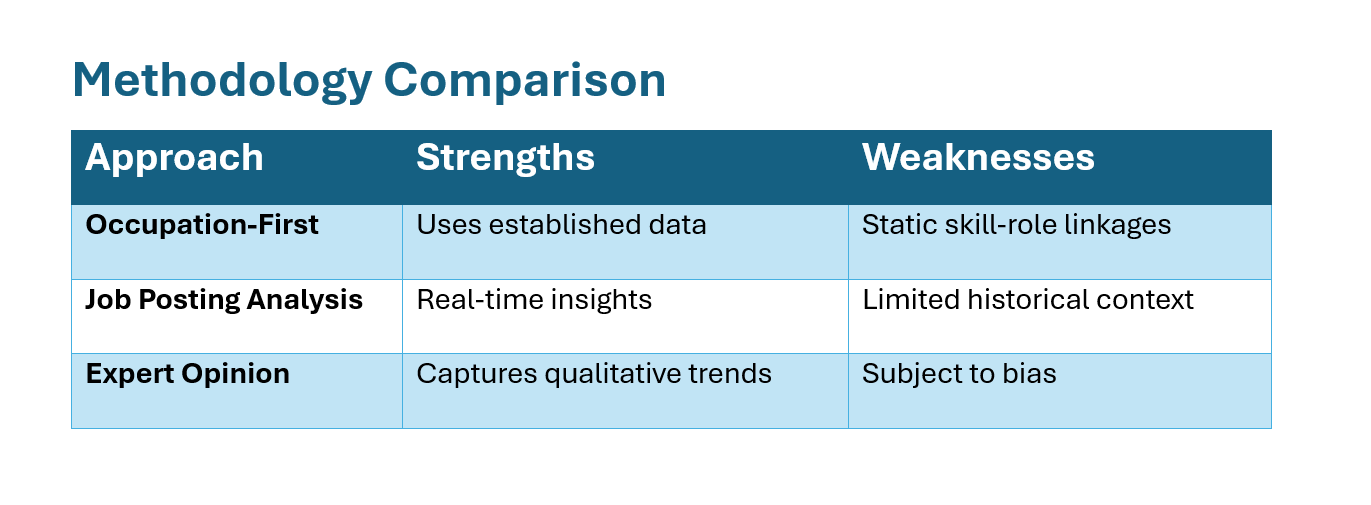
Approaches to Skills Forecasting
1. Occupation-First Forecasting:
Predict demand for roles like cybersecurity analysts, then map required skills (e.g., threat detection, compliance).
Tools: Labor Force Survey data, O*NET taxonomies.
2. Job Posting Analysis:
Analyze job ads for emerging skills (e.g., "blockchain developer" mentions grew 200% in 2024).
Example: JobsPikr tracks regional demand for cloud computing skills.
3. Expert Opinion Modeling:
Use Delphi method workshops to predict skill trajectories (e.g., healthcare experts forecasting telemedicine skills).
4. Hybrid Approaches:
Combine AI-driven labor market data with managerial insights for balanced forecasting.
Gathering and Analyzing Future Skills Data
Industry Reports: Leverage McKinsey’s DELTA framework to identify social, emotional, and cognitive skills.
Delphi Method: Conduct structured expert interviews to rank future skills (e.g., sustainability reporting for ESG roles).
Scenario Planning: Model skills needs for scenarios like AI regulation or supply chain disruptions
Competitor Analysis: Benchmark against companies like Siemens, which publicizes future skill priorities in annual reports.
AI and Predictive Analytics: Tool Example: IBM’s AI aggregates HRIS data, performance reviews, and market trends to predict skill demand.
Connecting Current Skills to Future Needs
Identifying Emerging Skills: Use AI to detect "adjacent skills" (e.g., a Java developer’s coding skills can transition to AI model training).
Skill Transferability Pathways: Map transitions like "customer service → chatbot training" using tools like Skills Matcher.
Gap Analysis: Compare current skills inventories (from Article 1) with forecasted needs. Prioritize gaps impacting strategic goals.
Prioritization Framework:
Criticality: Impact on revenue or compliance.
Feasibility: Time/cost to develop internally.
Scalability: Number of employees affected.
Creating a Future-Ready Skills Development Strategy
Learning Pathways: Design microlearning modules for high-priority skills (e.g., AI ethics certifications).
Talent Acquisition: Partner with coding bootcamps (e.g., IBM’s P-TECH program for AI talent).
Redeployment: Use skills adjacency matrices to shift manufacturing workers to robotics maintenance roles.
Educational Partnerships: Collaborate with universities on co-op programs for quantum computing roles.
Continuous Learning Culture: Implement AI-driven platforms like IBM’s Your Learning, which recommends personalized upskilling paths.
Real-World Examples of Successful Skills Forecasting Initiatives
Organizations across various sectors have implemented skills forecasting initiatives to proactively address workforce needs, align talent strategies with market trends, and gain a competitive edge. Here are several notable real-world examples:
Flanders, Belgium: Multilevel Skills Forecasting Framework
The Flemish region has developed a comprehensive skills forecasting framework that operates at the regional, industry, and business levels. This system guides labor market policy and helps align education and training with evolving workforce demands. Strategic Skills Forecast (SCOPE) projects, funded by the European Social Fund Plus (ESF+), have fostered dynamic partnerships among education, innovation, and business stakeholders. These collaborations produce tailored skills studies and actionable plans to address local and sector-specific skills needs, ensuring that training supply matches future labor market requirements.
Tech Startup: AI-Driven Skills Forecasting for Rapid Scaling
A technology startup leveraged predictive analytics to anticipate the rising demand for AI specialists. By integrating market trend data and internal workforce analytics, the company aligned its hiring and training programs with forecasted needs. This approach resulted in a 30% reduction in time-to-hire and accelerated product innovation, demonstrating how targeted forecasting can directly impact business agility and growth.
Green Energy Firm: Strategic Workforce Planning for Emerging Roles
A renewable energy company used labor market data to predict increased demand for energy storage specialists. By acting on these insights, the firm launched early recruitment and upskilling initiatives, enabling it to secure scarce talent ahead of competitors. This proactive strategy positioned the company as a leader in a rapidly evolving sector and ensured readiness for new market opportunities.
IBM’s P-TECH Initiative
Partners with high schools to align curricula with AI and cloud computing needs, creating a talent pipeline for roles like data engineers.
Renewable Energy Sector
A green energy firm used job posting analysis to forecast demand for energy storage specialists, securing early hires and avoiding project delays.
Amazon’s Upskilling 2025
Invested $1.2B in machine learning academies, reducing external hiring costs by 40%.
Lessons Learned:
Start Small: Pilot forecasting with high-impact departments.
Iterate: Update skills taxonomies quarterly using AI.
Measure ROI: Track metrics like time-to-productivity for upskilled employees.
These examples illustrate that successful skills forecasting initiatives typically combine data analytics, cross-functional collaboration, and proactive talent management.
Actionable Checklist for HR Managers:
Align with Strategy: Partner with executives to define 3–5 strategic skills priorities.
Leverage AI Tools: Implement platforms like LinkedIn Talent Insights for real-time labor market data.
Build Transition Pathways: Use skills adjacency matrices to redeploy 15–20% of the workforce annually.
Monitor Progress: Quarterly review of skills gap closure rates and adjustment of L&D programs.
By mastering skills forecasting, organizations can reduce hiring bottlenecks, enhance innovation, and maintain a future-ready workforce, ensuring they not only survive but thrive in the future of work.
Notes
https://www.jobspikr.com/blog/skills-demand-forecasting-techniques/
https://blog.getaura.ai/top-10-skills-employers-need-in-2025-and-how-to-close-the-talent-gap
https://www.apollotechnical.com/the-evolution-of-skills-management-trends-to-watch-in-2025/
https://www.techfunnel.com/hr-tech/future-ready-talent-skills-development/
https://cwdc.colorado.gov/resources/case-studies
https://www.onestream.com/blog/workforce-forecasting/
https://hr.mcleanco.com/research/ss/identify-skills-of-the-future
https://www.gtreasury.com/posts/forecasting-skills-cash-forecasting
https://blog.imocha.io/workforce-forecasting-software
https://www.jobspikr.com/blog/skills-demand-forecasting-techniques/